Alejandro Ferradas
Founder, Higher Consciousness
Co-Founder, Vibrational Revelations™
Co-Creator, Vibrational Frequency Analysis℠
What a century of science reveals about the field that surrounds and informs every human being, from Korotkov's electrophotonic imaging to biophotons, the heart's magnetic field, the bioelectric code and the inheritance of experience
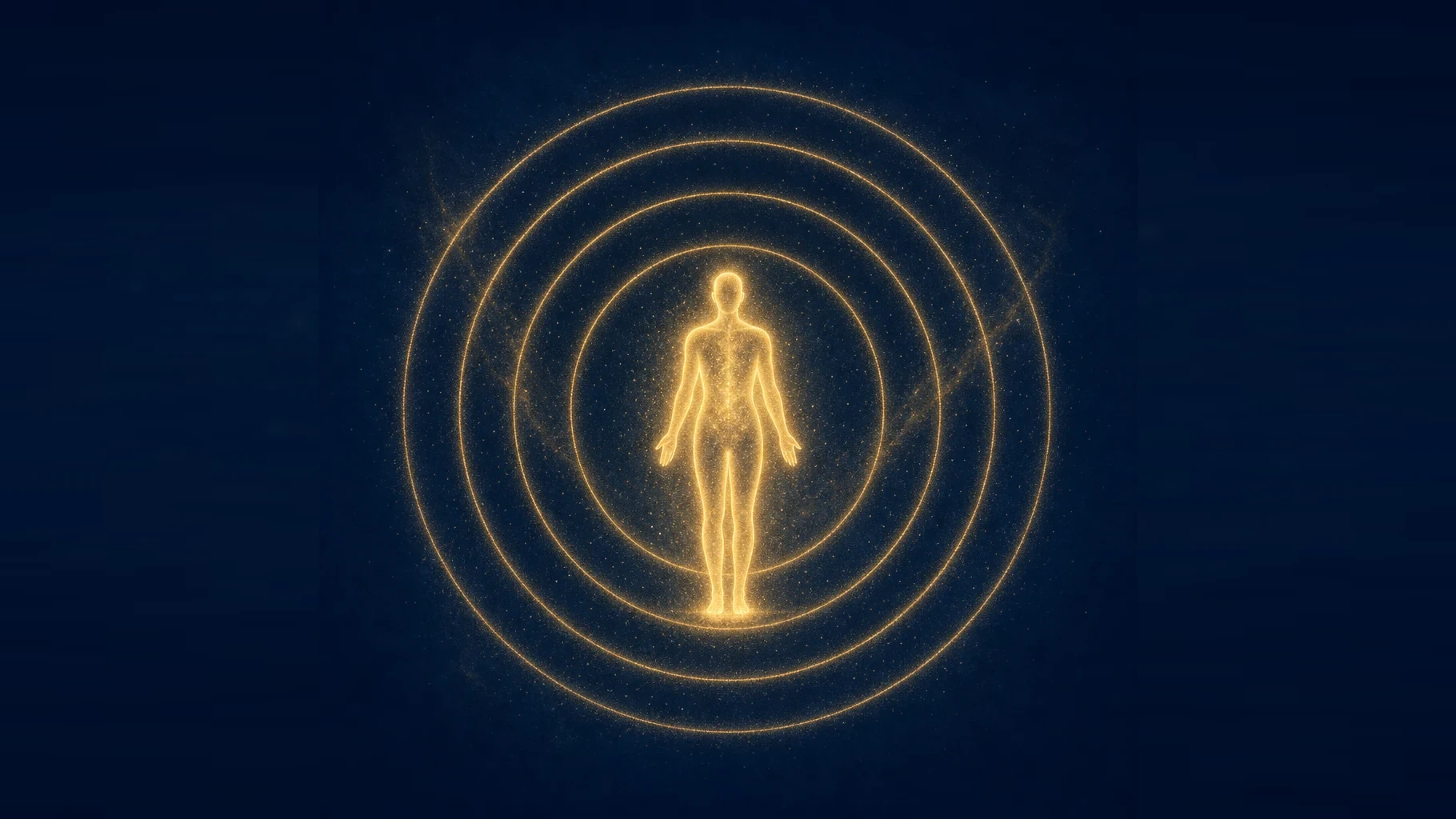
You are glowing right now.

Literally. In 2009, a team of Japanese researchers placed volunteers in a completely dark room in front of one of the most sensitive cameras ever built, and photographed light rising from the human face and body. The opening line of their paper reads like poetry, though it was published in a scientific journal: "The human body literally glimmers."1
That light is about a thousand times too faint for the eye to see. Yet it is there, it follows a daily rhythm, and it is only one of several layers of energy and information that science has now measured in and around the human being: light, electrical charge, a magnetic field that reaches beyond the skin, a voltage pattern that tells cells what to build, and molecular marks that carry the experience of one generation into the next.
For decades, spiritual traditions have spoken of a human field: the aura, the subtle body, the energetic blueprint. This article follows what researchers have actually found when they went looking for it. I keep three kinds of knowing distinct throughout: what has been measured, what remains under study, and how I interpret it through our work with Vibrational Frequency Analysis. Held together with clarity, they tell a remarkable story.
The story begins nearly a century ago with two scientists who were convinced that chemistry alone could not explain how a living being knows its own shape.
In Moscow in 1923, the Russian biologist Alexander Gurwitsch observed that dividing onion root cells appeared to emit a faint ultraviolet light that stimulated division in neighboring cells. He called it mitogenetic radiation and proposed that a biological field guided the development of the embryo.2 His ideas were set aside for decades, until improved photon detectors confirmed in 1962 that living cells do indeed emit ultraweak light.2
At Yale, the anatomist Harold Saxton Burr spent more than forty years measuring the electrical potentials of living things: salamander eggs, trees, slime molds and people. With the philosopher F. S. C. Northrop he published The Electro-Dynamic Theory of Life in 1935, proposing that every organism is organized by an electrodynamic field he called the L-field, or field of life.3 Burr believed this field acted as a blueprint for the body. Most scientists of his era set the theory aside, and some of his broader claims remain unproven.3 What is striking is how much of his central intuition, that electrical patterns guide the form of life, has returned at the forefront of biology today, as we will see.
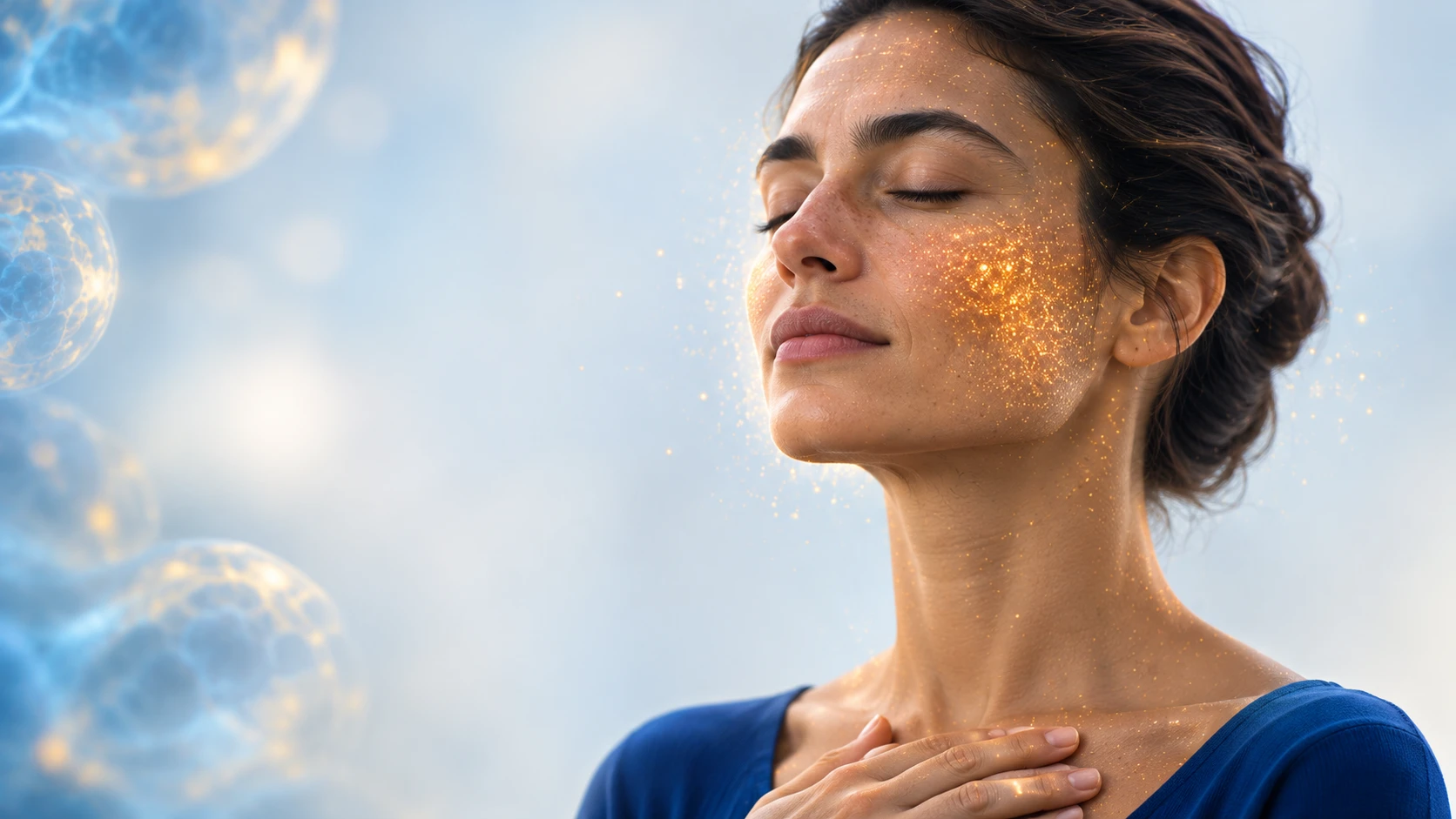
The faint light Gurwitsch glimpsed is now called ultraweak photon emission, or biophotons. The German biophysicist Fritz-Albert Popp devoted his career to it, coordinating early international research and proposing that this light may play a role in communication within and between cells.4 That proposal remains under study. The emission itself is well established.
The 2009 study by Masaki Kobayashi, Daisuke Kikuchi and Hitoshi Okamura, published in PLoS ONE, produced the first images of this light across the human body.1 Using a cryogenically cooled camera able to detect single photons, they photographed five healthy young men in total darkness every three hours over several days. Their findings:
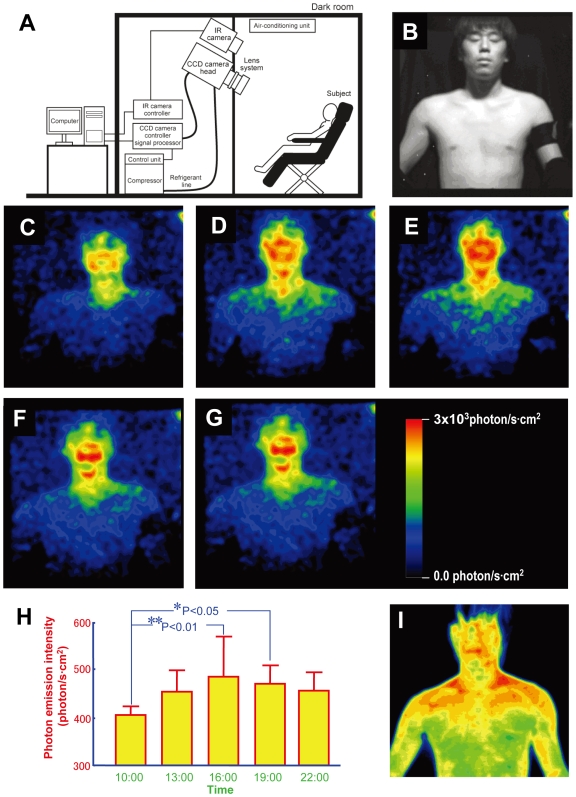
So the body is a source of light, and that light changes with our inner rhythms. In my understanding, this is one of the most beautiful findings in modern biology: the human being as a living source of light, its intensity rising and falling like a quiet tide.
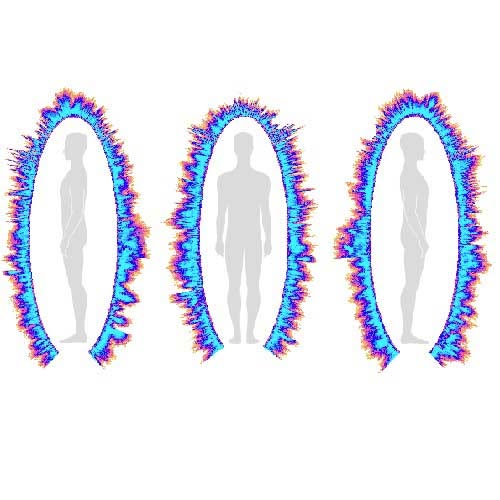
If the body glows on its own, what happens when that glow is stimulated?
In 1939, the Russian electrician Semyon Kirlian discovered that objects placed on a photographic plate in a high voltage electric field produce a radiant corona of light. Kirlian photography captured the imagination of the world, and in St. Petersburg the physicist Dr. Konstantin Korotkov spent decades transforming it into a modern scientific instrument.5
Korotkov's method is called Gas Discharge Visualization (GDV), also known as electrophotonic imaging, and its current form is the Bio-Well device. A brief, painless electrical impulse is applied to each fingertip. Electrons and photons are drawn from the skin, the surrounding air glows, and a camera records the light around each finger. Software then analyzes the area, intensity and complexity of each glow, and organizes the ten fingertip images into a composite picture of the person's state.6
Korotkov's work is extensive:
What the glow represents is still being explored. Physically, the image reflects the electrical and physiological state of the skin and body at the moment of measurement, which is why factors such as moisture, pressure and emotional state influence it.5 Korotkov interprets the patterns as a window into the person's energy and information state, connecting the fingertips to systems of the body through traditional acupuncture meridians. His work has done something historic: it turned the ancient idea of a luminous human field into something that can be photographed, quantified and compared, and it invites rigorous independent research to continue.

Of all the fields the body produces, the largest belongs to the heart.
With every beat, the heart generates an electrical field strong enough to be read anywhere on the skin: the electrocardiogram, or ECG. According to research summarized by Dr. Rollin McCraty of the HeartMath Institute, the heart's electrical field is about 60 times greater in amplitude than the brain's, and its magnetic field is about 5,000 times stronger. That magnetic field passes freely through tissue and can be measured several feet away from the body with superconducting magnetometers, known as SQUIDs.8
HeartMath's research then asked a remarkable question: can one person's heart signal register in another person's body? In their experiments, the ECG signal of one person was detected in the brainwaves (EEG) of another person when they held hands, and in some cases when they simply sat near each other.8 McCraty's team also reported that the rhythm of the heart changes with emotion: feelings such as appreciation and care produce a smooth, ordered rhythm they call coherence, while frustration and worry produce an irregular one.8
The size and reach of the heart's field are established physics. How much information it carries between people remains a frontier, and HeartMath's interpersonal findings await broader independent replication. Even so, the picture is profound. The organ we have always associated with love is also the body's strongest broadcaster, and the state of our heart, emotionally and rhythmically, shapes the field we bring into every room.
Burr's intuition that electricity shapes the body has found its most stunning confirmation in the laboratory of Dr. Michael Levin at Tufts University. Levin has described how reading Robert O. Becker's classic The Body Electric set the direction of his career.9
Every cell in your body holds a small voltage across its membrane. Levin's team discovered that cells use the patterns of these voltages to communicate what to build, and where:
Levin calls this the bioelectric code: a layer of information, above the genes, that guides how cells cooperate to create and maintain form.13 In the language of my work, this is the closest science has come to Burr's blueprint: a field of information that holds the shape of who we are and that the body returns to.

The final layer may be the most personal. It concerns what we carry from those who came before us.
In a study published in Nature Neuroscience in 2014, Brian Dias and Kerry Ressler of Emory University trained male mice to associate the scent of acetophenone, which smells like cherry blossom, with a mild shock. Their offspring, and the offspring of those offspring, showed a heightened sensitivity to that specific scent, though they had never encountered it. They also had more of the nerve cells that detect it. The father's sperm carried altered chemical marks, called methylation, on the very gene for that scent receptor.14 The experience of one generation had left a trace in the biology of the next two.
Human evidence points in a similar direction. During the Dutch Hunger Winter of 1944 and 1945, a wartime embargo brought famine to the western Netherlands. Six decades later, researchers found that people conceived during the famine carried different methylation of an important growth gene, IGF2, compared with their own siblings conceived before or after it.15 An experience from before birth remained written in the body for a lifetime.
The field of epigenetic inheritance is young, and scientists continue to debate how far these effects extend in humans. What is clear is that experience, environment and emotion can leave lasting marks on the information each of us carries.
This is the heart of what we explore in The Frequency You Inherited, and it is why the category of the Human Field matters so much in our work. The patterns we carry are partly our own and partly received. Seeing them clearly is the first step toward choosing what we carry forward.
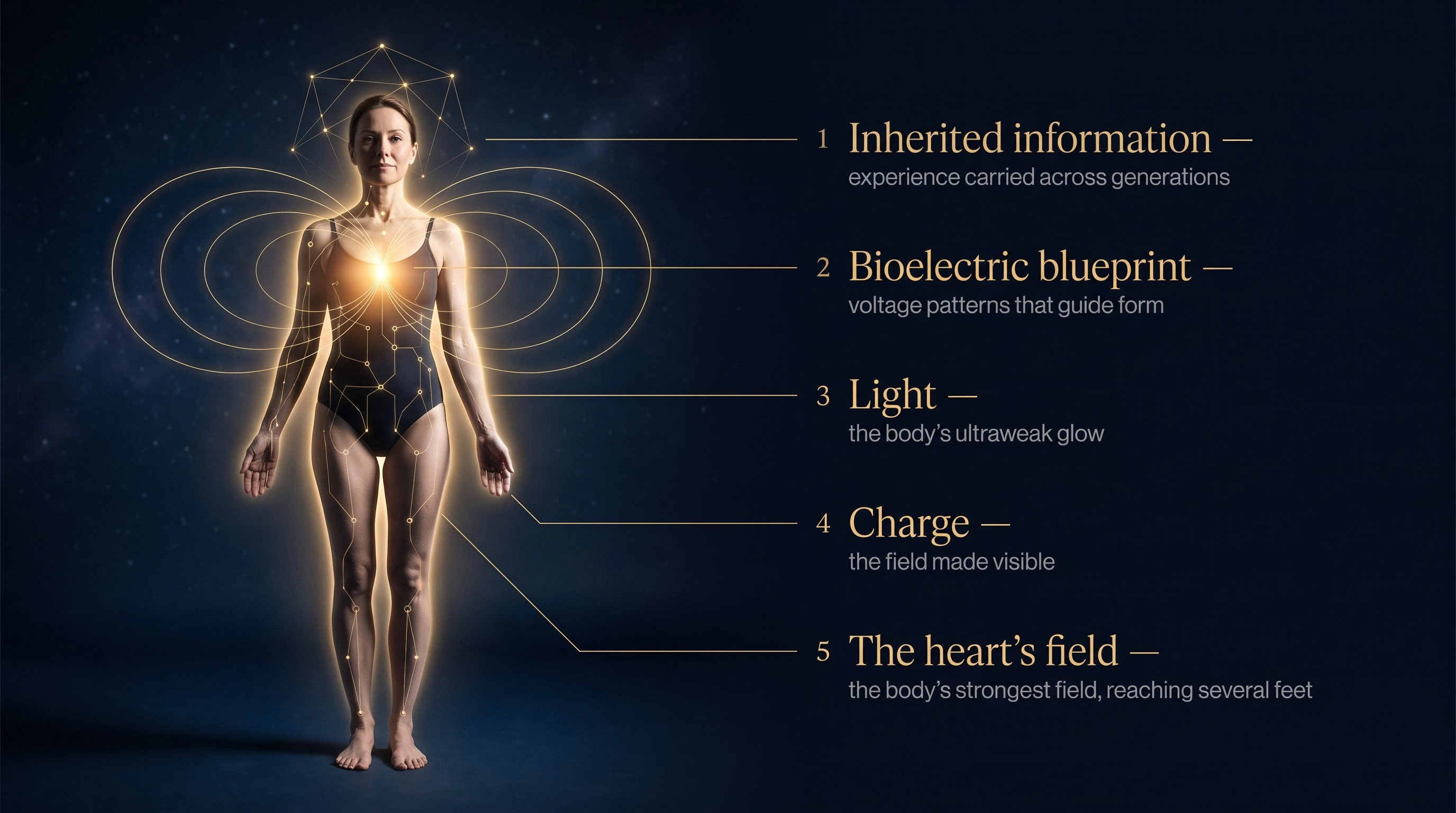
Conceptual illustration only—not to scale, and not a depiction of precise anatomical or scientific measurements.
| Layer | What has been measured | What remains open |
|---|---|---|
| Light | The body emits ultraweak light with a daily rhythm linked to metabolism1 | Whether this light carries information between cells4 |
| Charge made visible | Fingertip electrophotonic images change with physiological and emotional state6, 7 | What the images reveal about the wider human field |
| The heart's field | Electrical field about 60 times and magnetic field about 5,000 times the brain's, measurable several feet away8 | How much information it carries between people |
| Bioelectric blueprint | Voltage patterns guide anatomy and can store body plans independently of genes10, 11, 12 | How the bioelectric code operates in the human body |
| Inherited information | Experience can leave molecular marks that reach later generations14, 15 | How far and how strongly this occurs in humans |
Read together, these findings dissolve the old picture of the body as a machine made only of chemistry. The human being emerges as a living field: luminous, electrical, rhythmic, communicative and carrying information that reaches across time.

Every one of these discoveries describes the same truth from a different angle: information shapes form. A voltage pattern shapes a face. A heart rhythm shapes the field around it. An ancestor's experience shapes the sensitivity of a descendant.
This is precisely the territory of Vibrational Frequency Analysis. We describe the information each person carries as the Vibrational Blueprint: the emotional patterns, beliefs and resistance that shape how consciousness is expressed through a human life. Some of this information is present from the very beginning. In our readings, we identify a person's , the frequency of the emotions imprinted as they came into this life, and their Current Activated Resistance, the emotions being activated most often now.Frequency at Incarnation
Frequency at Incarnation is the vibrational signature your soul brought into form at the moment of incarnation, before the prenatal period and before birth. It is your familiar state. Even when the frequency drops at birth, this first frequency remains known behind the curtains: you already know what it feels like, and you navigate life reminded of your first experience in this reality, with that frequency to guide you. It serves as a reference point, and the path continues beyond it. Once you reach that level again, it is usually easier to rise even higher, because you arrive there with greater awareness gained through your own experience. Once you know, you know.Learn more
In our readings, we also observe a quality we call energy purity: how fully a person embodies their current level of consciousness. When energy purity reads at 90% and above, we observe a clear, coherent field. When it reads lower, we usually find interferences in the field that distort a person's connection with their higher self and with Source.
Science measures the field through light, voltage and magnetism. Our methodology reads the information it carries: the frequencies of awareness and resistance across 45 aspects of life. Both point toward the same invitation. The field is alive and responsive. It answers to attention, emotion and choice.
At the beginning of this article, I wrote that you are glowing right now. Let me add what the rest of the science suggests.
You are also broadcasting a rhythm from your heart that reaches beyond your skin. Your cells are holding an electrical memory of the form you are meant to keep. You carry information from generations before you, and you are writing new information for the generations after you.
You are a field of light, charge and memory. And as your awareness grows, so does your power to choose what that field expresses.
Discover your Vibrational Blueprint. Your Vibrational Frequency Analysis℠ reveals the emotional patterns, inherited beliefs and resistance your field carries across 45 aspects of life, so you know exactly where to begin.
Founder, Higher Consciousness
Co-Founder, Vibrational Revelations™
Co-Creator, Vibrational Frequency Analysis℠
 Consciousness
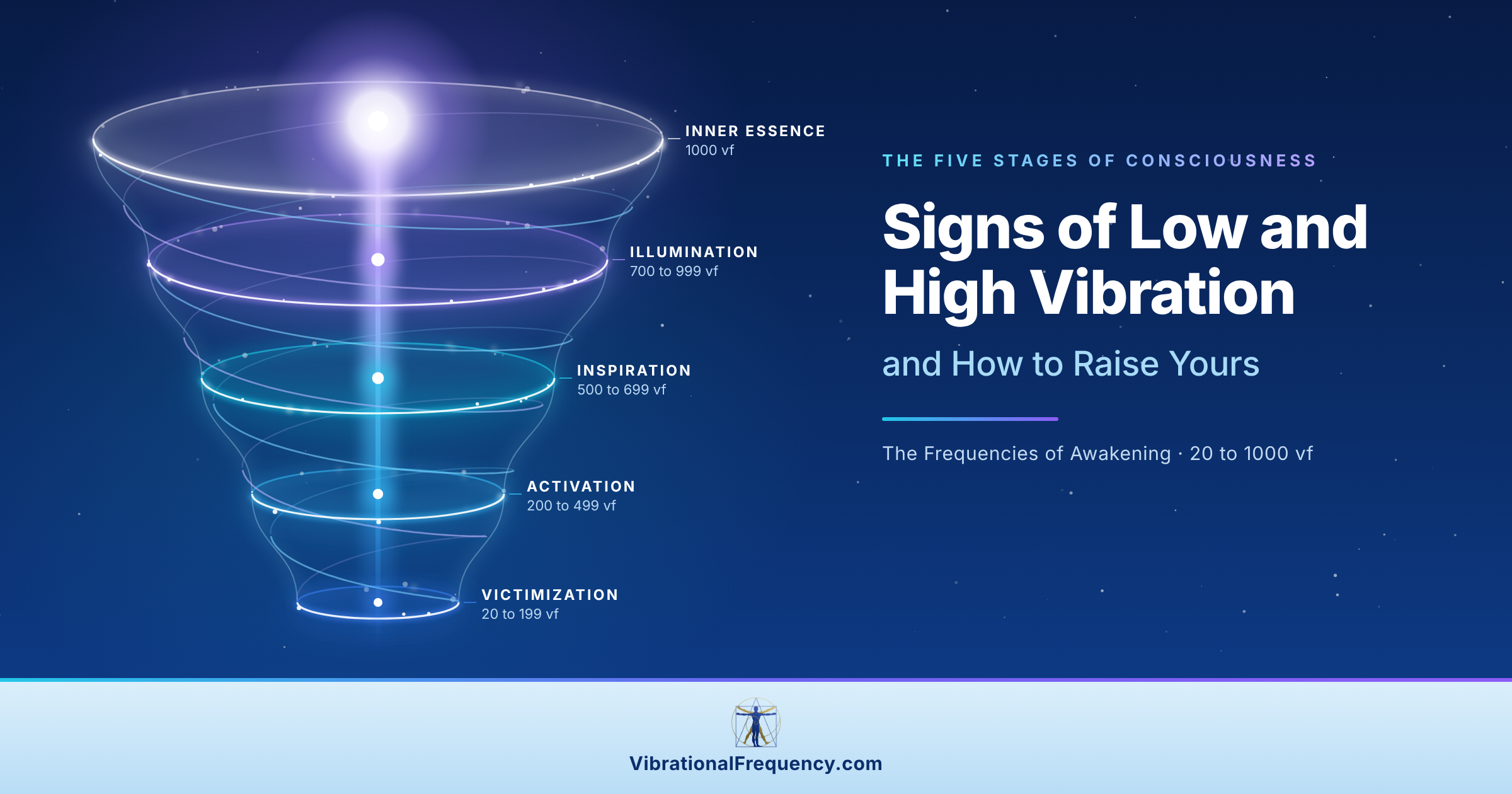
Recognize signs of low, rising, and high vibration. Explore the 18 Frequencies of Awakening and find a practical step for where you are today.
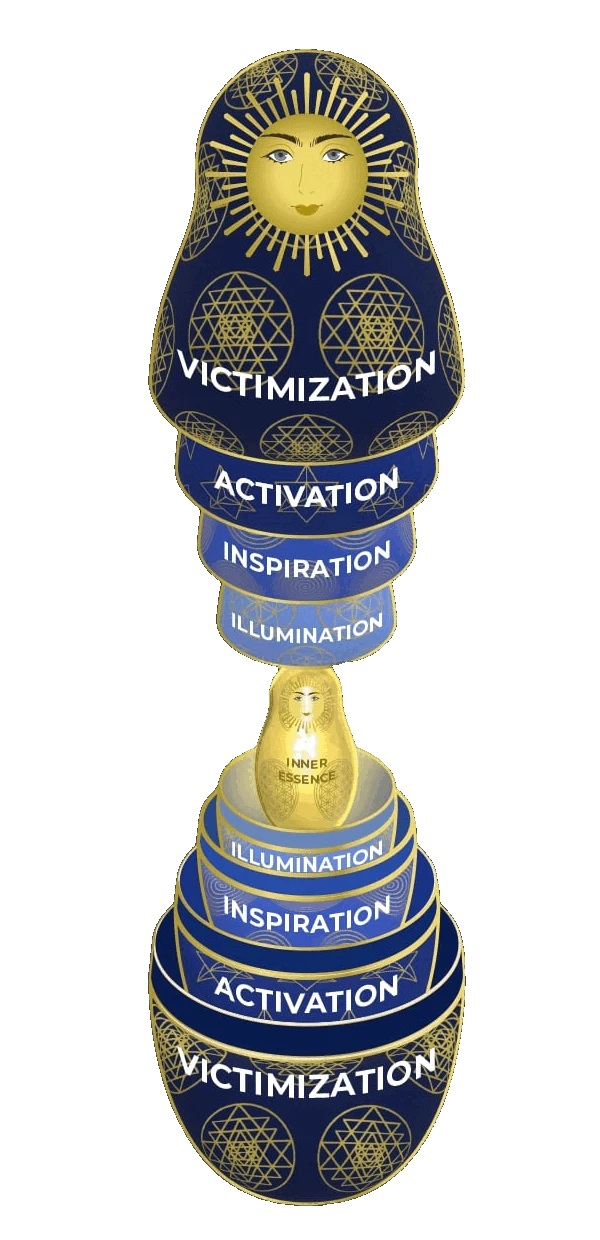
Read MoreThis article delves into the evolution of consciousness, detailing the five stages from Victimization to Illumination, highlighting empowerment and transformation.
Read MoreThe Frequencies of Awakening describe 18 levels of consciousness, from Humiliation to Inner Essence. Learn what each level feels like, how to locate yourself, and the practical steps that support movement from one level to the next.
Read More
“A level of precision that completely shifted how I see myself.”Dr. Jousch Andris BarblanFormer Secretary General, European University Association